The biggest lie in business right now isn't about AI. It's about resources.
I'm sitting in my home office in Somerset, building AI-native platforms in the UK legal and property sectors that would have required £2-3 million in funding and a team of 20+ people just three years ago.
I'm doing this solo, while maintaining client work, with two children at home.
This isn't a humble brag. It's evidence of a fundamental shift that most businesses are completely missing.
The old world said: "We can't afford to build that." The new world says: "We can't afford NOT to build that."
The bottleneck has flipped. The question is no longer "can we execute?" but "what should we execute?" And if you're still operating under the old assumptions, you're not just behind—you're building for a world that no longer exists.
Part I: The Scarcity Model Everyone Still Believes
Let's start with the math that everyone accepts without question:
Want 10 new features? Hire 10 engineers.
Want to test 5 markets? Build 5 teams.
Want to scale? Raise millions.
Success metric? Revenue per employee.
This is the inherited wisdom of the industrial era, carried forward into the knowledge economy, and now colliding violently with the AI era.
The Evidence of Collapse
In January 2025, McKinsey announced a 10% workforce reduction. Not because of a recession. Because when insight becomes abundant, execution becomes scarce. When strategy can be generated algorithmically, implementation becomes the only sustainable competitive advantage.
The consulting industry's reckoning is just the most visible symptom. The fundamental economics have shifted:
Midjourney: $200M+ revenue with 11 full-time employees
Cursor: $100M+ ARR achieved rapidly with a tiny team
Lovable: $17M ARR with minimal headcount
Gumroad: $2M+ annually with essentially one person (founder + interns)
These aren't outliers anymore. They're the vanguard of a new business model—what Henry Shi calls "Lean AI Native" companies. There's now a Lean AI Leaderboard tracking companies generating over $1M ARR per employee, and the list is growing weekly.
The Hidden Cost of Scarcity Thinking
Here's what kills me when I talk to established businesses:
88% of organizations use AI in at least one business function. Sounds impressive, right?
But only 34% are truly transforming their businesses with it.
The rest? They're spreading AI "thin"—running 50 small pilot projects, waiting for "the right time," confusing activity with progress. They're applying abundance-era technology to scarcity-era thinking.
A recent Deloitte study found that organizations implementing AI properly report 40-50% time savings on core workflows. Not incremental improvement. Structural transformation.
Yet most companies are still optimizing the wrong equation. They're asking "how can we use AI to make our people 10% more productive?" instead of "how can we use AI to multiply our capacity by 10x?"
Part II: The Abundance Revelation—A Framework
I didn't figure this out from reading business books. I figured it out from swimming the Bristol Channel.
In ultra-endurance athletics, I achieve performance—including completing one of the world's toughest swims—with 10-15 hours of weekly training. Most athletes attempting the same challenges train 25-30 hours per week.
The difference isn't genetics or grit. It's technique refinement before volume scaling.
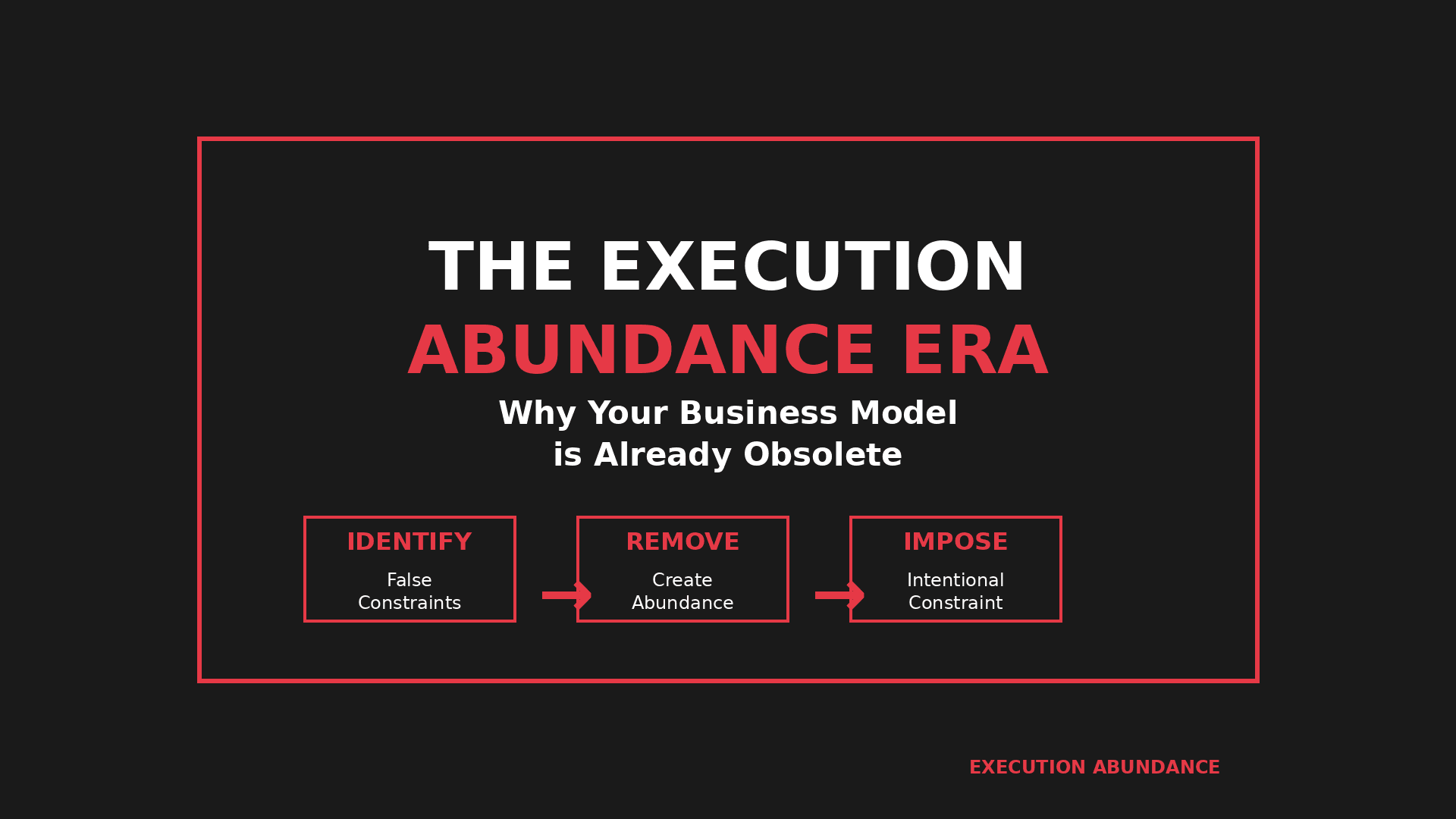
This principle became my "Execution Abundance" framework:
Identify false constraints
Remove them to create abundance
Impose intentional constraints to focus energy on maximum value generation
Let me show you how this plays out in business.
Phase 1: Identify False Constraints
Most constraints are inherited beliefs, not reality.
When I started building in the legal tech space, I believed I needed to find partners first. That was the constraint: "I can't validate this model until I have partners to test it with."
False.
What I actually needed was to understand the market completely—regulatory requirements, competitive landscape, financial profiles, geographic density of qualified candidates. Only then could I intelligently select partners.
The constraint wasn't "lack of partners." It was "lack of comprehensive market intelligence."
The key question: "What am I accepting as impossible that's actually just inefficient?"
For most businesses, these false constraints include:
"We need a big team to enter this market"
"We need significant capital before we can start"
"We need to build everything before we can validate anything"
"We need traditional expertise in this industry"
"We need to move slowly to maintain quality"
Phase 2: Remove Constraints to Create Abundance
Once I identified the real constraint, I removed it systematically.
I built comprehensive data gathering infrastructure that could analyze hundreds of potential partners across multiple dimensions—regulatory compliance, financial health, geographic fit, capacity metrics, performance indicators.
I developed sophisticated scoring systems to evaluate opportunities objectively rather than relying on gut feel or limited sample sizes.
I invested in interactive prototypes and market intelligence tools.
Before making a single sales call.
This is abundance thinking. I removed the constraint of "not knowing enough" by building tools that made comprehensive market intelligence abundant. Now I can evaluate hundreds of potential opportunities in the time it would have taken to have discovery calls with ten.
MIT research shows this pattern clearly: Organizations moving from "Existing+" models (AI as a helper) to "Orchestrator" models (AI assembling entire ecosystems) unlock structural, not incremental, scale.
Phase 3: Impose Intentional Constraints
Here's where most people get abundance wrong. They think it means doing everything.
It means the opposite.
Abundance gives you the power to be ruthlessly selective.
Instead of pursuing every opportunity that abundance reveals, I focus on the highest-value prospects. Not ten opportunities. One or two at a time—the highest-scoring candidates who can demonstrate transformational results before I scale.
I impose geographic constraints. Market segment constraints. Quality threshold constraints.
I design business models with intentional forcing functions—payment structures that eliminate entire categories of operational problems, partnership models that align incentives perfectly from day one.
This is the abundance framework in action: Remove false constraints to create abundance of capability, then impose intentional constraints to create abundance of value.
Part III: The New Business Models (What Winners Are Actually Doing)
Let me show you what this looks like across different contexts.
Model 1: The One-Person Powerhouse
Individual builders are creating what previously required entire companies.
Consider the pattern emerging across industries:
Legal tech
: Solo founders building comprehensive practice management platforms
Healthcare
: Individual developers creating patient engagement systems
Finance
: One-person teams launching trading platforms and portfolio management tools
Education
: Solopreneurs building entire curriculum delivery systems
The model works because they're not trying to do everything—they're orchestrating AI to handle execution while they focus on strategic decisions and high-value relationships.
Key insight: They're not coding faster. They're coding less and orchestrating more.
Current examples of this pattern:
Building what required £2-3M and 20-person teams just three years ago
Maintaining lean operations (£6-10K monthly expenses) while generating sustainable revenue
Targeting complete independence from client work within 12-18 months
Achieving significantly higher earning potential with dramatically lower operational overhead
Model 2: The Lean AI Native Pattern
Companies on the Lean AI Leaderboard share common characteristics:
Product-centricity
: The product is the primary engine of growth
AI-native workflows
: Built around AI from day one, not bolted on
Extreme capital efficiency
: $1M+ revenue per employee
Automated customer acquisition
: Product-led growth with AI removing friction points
Take Cursor as an example. They're building an AI-native code editor that's reportedly generating $100M+ ARR with a small team. They didn't build a traditional code editor and add AI features. They reimagined what a code editor should be in an AI-abundant world.
The result? They're valued as a tech platform (8-15x revenue multiples) rather than a software tool (2-4x multiples).
Model 3: The AI-Enabled Service Transformation
General Catalyst has pioneered what they call the "AI-enabled roll-up strategy." Their portfolio shows the pattern:
Eudia
: Automating legal workflows
Titan
: Reducing IT onboarding from weeks to minutes
Dwelly
: 40% faster repair times in property management
CrescendoCX
: 70-80% automation in customer service
The thesis: Double-digit growth and operational efficiency are no longer a tradeoff. They reinforce each other.
Service industries generate multiple trillions of dollars annually in the U.S.—substantially exceeding the entire $370 billion software market—yet remain largely untouched by meaningful AI integration.
Why? Because they're still operating under scarcity models.
Model 4: The Ecosystem Transformation Play
The most sophisticated abundance thinkers aren't just building products—they're building platforms that orchestrate entire industries.
The pattern across sectors:
Phase 1: Enter with deep vertical solution
Target underserved segment with AI-native offering
Demonstrate 40-60% efficiency gains
Build credibility through measurable outcomes
Phase 2: Expand into adjacent services
Layer complementary offerings around core value
Increase revenue per customer 2-3x
Create switching costs through ecosystem lock-in
Phase 3: Become infrastructure layer
Open platform to third-party providers
Shift from service provider to orchestrator
Unlock platform economics and network effects
Phase 4: Scale through creative capital structures
Use profit-sharing over equity dilution
Acquire competitors with minimal capital deployed
Build toward market leadership position
Examples emerging across industries:
Fintech platforms starting with payments, expanding to banking, insurance, investments
Healthcare companies beginning with scheduling, growing into patient engagement, clinical workflows, billing
Supply chain tech entering via tracking, extending to procurement, inventory, logistics
The key: These aren't five-year moonshot plans. They're 18-24 month execution roadmaps enabled by abundance thinking.
Part IV: The Implementation Playbook
Enough theory. Here's how to actually do this.
For Solopreneurs and Small Teams
1. Start with Infrastructure, Not Features
Wrong approach: Build a product, then figure out go-to-market.
Abundance approach: Build market intelligence infrastructure first.
The companies winning in AI-native markets build comprehensive understanding before building products:
Comprehensive databases of potential customers/partners
Intelligent scoring and matching algorithms
Geographic and demographic heat maps
Competitive landscape analysis
Pricing sensitivity and willingness-to-pay models
This creates abundance of market knowledge, which means every product decision is informed, not guessed.
Example from service industries: A property management platform spent 6 months building data infrastructure analyzing 10,000+ buildings across regulatory compliance, ownership structures, service quality metrics, and financial performance before writing a single line of customer-facing code.
Result? They knew exactly which 50 buildings to target first, what price point they'd accept, and which pain points mattered most. First customer signed in week 2 of launch.
Your version: What data infrastructure would give you 100x better market understanding? Build that first. Use AI tools to help you build scrapers, analyzers, and intelligence systems.
2. Impose Forcing Functions
A forcing function is an intentional constraint that makes the "hard thing" automatic.
Traditional SaaS: Invoice monthly, chase payments, manage churn, negotiate contracts.
Abundance-era forcing function: Usage-based pricing with instant settlement through payment infrastructure (Stripe, embedded finance platforms).
Result:
Zero accounts receivable
Perfect product-market fit feedback (usage = value)
Eliminates entire sales and collections operations
Scales revenue without scaling headcount
Other forcing function examples:
E-commerce platform:
Require sellers to maintain 4.5+ star rating or automatically pause their storefront. Forces quality without manual moderation.
API business:
Give away generous free tier, charge only for production usage above threshold. Forces users to validate value before you invest in their success.
Marketplace:
Hold funds in escrow until both parties confirm satisfaction. Forces good behavior without building dispute resolution team.
Your version: What single constraint could you impose that eliminates an entire category of problems? What forcing function would align incentives automatically?
3. Leverage AI for Multiplication, Not Addition
Not: "AI helps me write emails faster."
But: "AI conducts initial qualification conversations with prospects while I focus only on those who meet specific criteria."
Not: "AI helps me analyze data."
But: "AI continuously monitors thousands of signals across multiple sources and alerts me only when specific conditions are met."
The difference is architectural. You're not using AI to do your existing job faster. You're redesigning your job around what AI can handle completely, so you focus only on uniquely human value-add.
Real examples:
Customer support company:
Instead of "AI helps agents answer faster," they built "AI handles 70% of inquiries end-to-end, agents focus only on complex cases requiring empathy or creative problem-solving."
Investment research firm:
Instead of "AI helps analysts read reports," they built "AI monitors 10,000+ companies continuously, analysts investigate only the 20-30 that meet our specific criteria each quarter."
Legal practice:
Instead of "AI helps lawyers draft faster," they built "AI handles entire document review and initial drafting, lawyers provide strategic counsel and client relationship management."
For Established Businesses
1. Question Inherited Structure
Most organizational structure exists because "that's how it's always been."
Ask yourself:
Which departments exist only because nobody has automated them yet?
Which processes require humans only by tradition, not necessity?
Which constraints are protecting margins vs creating value?
IBM's transformation under CEO Arvind Krishna provides a blueprint. They set a goal to become "the most productive company in the world" and achieved $4.5 billion in productivity gains in two years.
How? By rethinking and reshaping every aspect of how the business operates with AI at the core.
Not by running pilots. By committing to transformation.
2. Use Gradual Transformation Models
You don't have to blow everything up at once. The smartest organizations create hybrid transition paths:
Stage 1: Pilot validation with limited scope
Maintain current operations
Validate new model with subset of activity
Low risk, high learning
Stage 2: Parallel operation during transition
Run both old and new models simultaneously
Measure performance differences objectively
Build confidence through demonstrated results
Stage 3: Full transition with alignment structures
Shift entirely to new model
Align incentives for long-term value creation
Lock in gains with new operational processes
Real example - Professional services firm: They didn't fire their entire analyst team when they adopted AI. They:
Pilot: Had 3 analysts use AI tools for 3 months while others worked traditionally
Parallel: Demonstrated 60% faster delivery with same quality, expanded to full team
Transition: Redeployed analysts to higher-value strategy work, took on 3x more clients with same headcount
This works because it removes the constraint of "all-or-nothing" transition while creating abundance of validation data.
3. Pick Focused Bets, Not Broad Experiments
PwC's 2026 AI predictions are clear: Companies that succeed pick 2-3 key workflows where AI can deliver wholesale transformation, then execute with "steady discipline that starts with senior leadership."
Not: 50 small pilots spread across the organization.
But: Senior leadership selects focused areas where:
Business priorities align with AI capabilities
Evidence of value is already proven elsewhere
Talent and data are available
Success compounds into adjacent areas
Measure: Deployed systems generating measurable business outcomes.
Not: Number of pilot projects or presentations delivered.
MIT research shows this clearly: Organizations with top-down AI programs centered in an "AI studio" (centralized hub with reusable tech components, frameworks for assessing use cases, sandbox for testing, deployment protocols) achieve dramatically better results than those crowdsourcing initiatives bottom-up.
Part V: The Uncomfortable Truth
Here's what nobody wants to hear:
In 2026, you will look back and realise you were constrained by beliefs that stopped being true in 2024.
The companies winning right now aren't smarter than you. They don't have better access to AI tools (you're using the same Claude, ChatGPT, and APIs they are).
They just removed constraints faster.
They built abundance models while everyone else optimized scarcity models.
Three Questions to Ask Yourself Tonight
1. What am I treating as a resource constraint that's actually an execution constraint?
Is it really that you "don't have enough engineers" or that you haven't automated the execution layer enough to multiply your existing engineers' output by 10x?
2. If I could build 10x what I'm building now with the same team, what would I prioritize?
This question reveals what you actually value vs what you're doing because of inherited constraints.
3. What false constraint am I protecting because removing it feels uncomfortable?
Sometimes we cling to constraints because they're familiar. "We need to move slowly to maintain quality" often means "We're uncomfortable with the speed that's now possible."
The Pattern You're Seeing Everywhere
Deloitte: 34% of organizations are truly reimagining their businesses, not just optimizing existing processes
World Economic Forum: AI-native enterprises will run on continuous feedback loops with flatter structures and real-time decision-making
MIT: Business models are evolving from "Existing+" (augment with AI) to "Orchestrator" (use AI to assemble ecosystems with no predetermined process)
Translation: The winners are removing constraints and building abundance models. The losers are adding AI features to scarcity models.
Your Competitors Aren't Waiting
While you run another pilot project, someone in their spare bedroom is building the platform that will make your entire business model obsolete.
Not because they're better funded. Because they started with abundance assumptions instead of scarcity assumptions.
Not because they have a bigger team. Because they removed the constraint that made them think they needed one.
Not because they got lucky. Because they imposed intentional constraints that focus execution on maximum value instead of spreading effort across everything that feels important.
About the Framework
The Execution Abundance framework stems from 15+ years of ultra-endurance athletics, where elite performance comes from technique refinement before volume scaling. Applied to business in the AI era, it provides a systematic approach to:
Identifying false constraints inherited from the pre-AI world
Removing them to create abundance of capability
Imposing intentional constraints to focus energy on maximum value generation
I'm building AI-native platforms in the UK legal, property, transport sectors, applying these principles to achieve what previously required multi-million pound raises and large teams—while maintaining complete independence and family commitments.
Want to discuss how this applies to your specific business? The bottleneck isn't resources—it's recognition. Once you see the constraints clearly, removing them becomes straightforward.
Found this valuable? Share it with someone still operating under scarcity assumptions. The faster we collectively shift to abundance thinking, the faster we build the companies that should exist.
Matt Todd
Founder & CEO, Fluent Forward
After more than a decade implementing BI systems across industries and watching them consistently fail to achieve adoption, Matt founded Cognify to solve the fundamental problem: people don't open dashboards. Previously an enterprise consultant specializing in digital transformation and business intelligence.
Learn more about our story →